The untapped potential of remanufacturing
This article was originally published in Futuribles.
Renault’s most profitable plant does not manufacture new engines; it disassembles used ones. The Choisy-le-Roi plant completely dismantles, cleans, inspects, reassembles, and then tests engines and gearboxes sourced from garages within the Renault network.
Remanufacturing, the process of restoring used products to a quality level identical to that of new products (see figure), is not new.
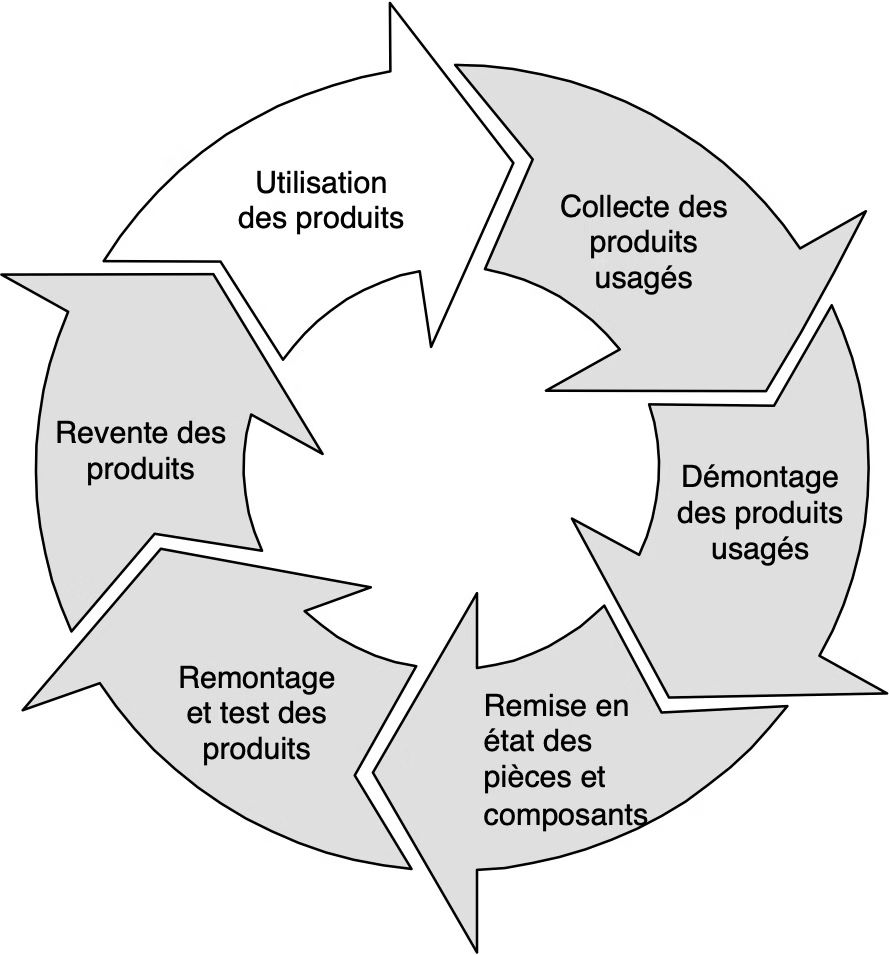
Xerox has been remanufacturing its printers since 1987, Caterpillar its diesel engines since 1973, and Renault its mechanical parts since 1949! Nevertheless, remanufacturing is seeing renewed interest from manufacturers facing rising raw material costs and customer demand for low-cost products. Today, it is commonly applied to high-cost products that rely on technologies that evolve slowly, such as vehicle spare parts, electric motors, industrial machinery, and medical equipment. Examples include Valeo remanufacturing alternators; Rockwell Automation, electrical equipment; Cummins, engines; SKF, ball bearings; Siemens Healthcare, medical equipment; Kässbohrer, snow-grooming vehicles; Nextant Aerospace, business jets; and Neopost, mail-processing equipment.
In the United States, the market for remanufactured products—valued at US$41.5 billion in 2011—grew by 15% in just two years. In China, the government has launched a five-year program to support remanufacturing, while Singapore has opened a major research center. Most recently, at the request of a group of MPs, the United Kingdom launched an assessment of the challenges and constraints associated with remanufacturing [1].
However, in France, the remanufacturing industry remains poorly organized and often little known. Evidence of this lies in the fact that there is no standard French translation for the word “remanufacturing”: the terms “remanufacturer” and “refabriquer” are not recognized French words. Yet, remanufacturing offers tremendous economic, environmental, and social potential. It could be twice as profitable as traditional manufacturing [2]. Indeed, while the selling price of a remanufactured product can be up to 40% lower than that of a new one, and the labor cost for remanufacturing is often significant, material costs are much lower. Manufacturers can also leverage new technologies to reduce the cost of the remanufacturing process. For instance, Komatsu uses sensors installed in its construction and mining machinery to collect operational data, thereby facilitating the equipment’s remanufacture.
By sourcing products that have already undergone partial processing, remanufacturing also has a much lower environmental impact than manufacturing the same product from scratch. For example, remanufacturing an automobile engine consumes up to 90% less material and generates up to 88% less waste than manufacturing a new engine [3].
Remanufacturing also creates local jobs. In the United States, for example, the sector employs 180,000 full-time workers [4]. On one hand, the productivity of a reassembly operation is often lower than that of the initial assembly of the same product. Remanufacturing a Xerox printer, for instance, requires twice as much labor as manufacturing it and calls for a more skilled workforce [5]. On the other hand, remanufacturing used products often relies on local or regional employment. The often-high cost of transporting used products and the relatively low cost of setting up remanufacturing plants, which are difficult to automate, encourage companies to locate these facilities near consumer markets. Renault, Ricoh, and Canon, for example, all operate remanufacturing facilities in Europe.
Given the stakes involved, why isn’t remanufacturing more widely adopted? Undoubtedly because a manufacturer opting for remanufacturing must completely overhaul its business model. It must design products with remanufacturing in mind. It must establish reverse logistics to recover used products and implement a remanufacturing process—often vastly different from the original manufacturing process. It must engage with new suppliers—the owners of used products—and acquire new customers, who are not necessarily the same as those who buy new products. Finally, it must contend with new competitors: companies specializing in the refurbishment of used products.
Despite these obstacles, remanufacturing offers significant potential for addressing resource scarcity. According to a recent study [6] on the future of the UK manufacturing sector, remanufacturing—which currently accounts for just 1% of total manufacturing revenue [7]—is poised for strong growth. It also represents a tremendous opportunity for the future of French industry.
[1] « Inquiry: Remanufacturing – Resource Security & Opportunity for Growth », All-Party Parliamentary Sustainable Resource Group, août 2014. URL : http://www.policyconnect.org.uk/apsrg/research/inquiry-remanufacturing-resource-security-opportunity-growth
[2] LAVERY Greg et alii, Next Manufacturing Revolution Report, Londres : Lavery and Pennell, 2013. URL : http://www.nextmanufacturingrevolution.org/
[3] SMITH Vanessa M., KEOLEIAN Gregory A., « The Value Of Remanufactured Engines: Life- Cycle Environmental And Economic Perspectives », Journal of Industrial Ecology, janvier 2004. URL : http://onlinelibrary.wiley.com/doi/10.1162/1088198041269463/abstract
[4] USITC (United States International Trade Commission), Remanufactured Goods: an Overview of the U.S. and Global Industries, Markets, and Trade, Washington, D.C. : USITC 2012. URL : http://www.usitc.gov/publications/332/pub4356.pdf
[5] UNEP (United Nations Environment Programme), Green jobs : Towards Decent Work in a Sustainable, Low-carbon World, Nairobi : PNUE, 2008. URL : http://www.ilo.org/wcmsp5/groups/public/—dgreports/—dcomm/documents/publication/wcms_098504.pdf
[6] GOS (The Government Office for Science), The future of manufacturing: A new era of opportunity and challenge for the UK, Londres : GOS, 2013. URL : https://www.gov.uk/government/uploads/system/uploads/attachment_data/file/255922/13-809-future-manufacturing-project-report.pdf
[7] LAVERY Greg et alii, op. cit.