Remanufacturing: a major opportunity for tomorrow‘s industry
What is remanufacturing?
Remanufacturing is the industrial process of restoring used products to a quality level identical to that of new products. In most cases, the warranty period for a remanufactured product is identical to that of a new product.
Little known in Europe, remanufacturing has nonetheless existed for nearly a century. Ford has remanufactured its engines since the 1930s, Renault its mechanical parts since 1949, Caterpillar the components of its construction equipment since 1973, and Xerox its printers since 1987.
The remanufacturing process
Remanufacturing is a process that has proven itself for nearly a century. Restoring used products to like-new condition follows a four-step process.
After being collected through reverse logistics, used products are received, inspected, cleaned and sorted. Those that cannot be economically restored are discarded. Others, in better condition, may also be set aside to limit variability in the remanufacturing process.
The products are then disassembled. The level and sequence of disassembly operations should ideally be known before this step begins. Disassembly can be total, when the product is broken down into each of its individual parts, or partial, when the product is not fully disassembled. The sequence of operations is defined to minimize production costs. It becomes harder to determine as the number of parts and components to disassemble increases.
Once disassembled, parts and components are cleaned. Cleaning can be carried out through a mechanical, chemical, or thermal process. A mechanical process removes contaminants by brushing, sanding, or shot blasting. A chemical process dissolves contaminants using solvents. A thermal process removes paint, grease, or adhesives by varying temperature.
Parts and components are then sorted. Significant effort can be required to sort parts, such as screws, that look similar but are actually different.
Parts and components are then inspected and sorted into three categories: reusable as is, reusable after restoration, and not reusable. Parts that cannot be reused, because they are too worn or too old, are discarded and sent, where possible, to recycling facilities. The remaining parts are stored.
Restoring parts and components, when necessary, must comply with the original manufacturer’s specifications. This can involve, for example, heat treatment, machining a metal part, welding two parts together, or painting a component. Components and parts are then tested.
The restored parts are finally assembled into components, which are themselves assembled into products. New parts may be used if restored ones are not available. Assembly can also include a technology upgrade. The reassembled products are tested. Typically, a remanufactured product undergoes more testing than a new product. The product is finally packaged for sale.
The global remanufacturing market
The global remanufacturing market, for which no precise estimate exists, is thought to exceed €100 billion[1].
The U.S. market, sometimes called “the hidden giant,” alone represents more than €40 billion, including €1.6 billion in exports[2]. It is larger than the European market, estimated at €30 billion[3]. For example, the market for remanufactured automotive components is proportionally three times larger in the United States than in Europe[4]. While nearly 10% of office furniture is remanufactured in the United States, less than 1% is in France.
While the size of the French market is unknown, the UK market has been estimated at €3.4 billion, with potential of at least €8 billion[5].
Growth in the remanufacturing market is also reportedly very high. It reached 7% per year in the United States between 2009 and 2011[6]. As a result, remanufacturing plants keep opening: Philips has just launched a plant dedicated to the full overhaul of medical systems in the Netherlands, Komatsu has opened its thirteenth construction equipment remanufacturing plant in Myanmar, while Bendix has started a new production line for remanufactured compressors. Daimler-Benz is reportedly considering building the world’s largest remanufacturing plant in Shanghai.
Industries involved in remanufacturing
Not all products, however, are suited to remanufacturing. A remanufacturable product generally meets three criteria.
First, it is subject to little technological or regulatory change. Smartphones, generally not very modular and built on constantly evolving technology, are rarely remanufactured.
Second, it must be easy to restore. In particular, it must be possible to disassemble and reassemble it. Its parts and components must be interchangeable. Many engines and gearboxes are remanufacturable.
Finally, the product must have high value. In a car, alternators are very often remanufactured, while electric window motors are remanufactured much more rarely.
The main industries involved in remanufacturing are listed in the table below.
Table : Sectors involved in remanufacturing
| Sector | Examples of remanufactured products |
| Automotive | Alternator, starter, engine, gearbox, water pump |
| Construction equipment | Engine, water pump, alternator, starter, brake |
| Aerospace and defense | Engine, landing gear, avionics |
| Rail transport | Engine, axle |
| Office furniture | Desk, chair, cabinet |
| Electrical equipment | Transformer, electric motor, air conditioning, refrigerator |
| Industrial equipment | Valve, turbine, machine tool, compressor |
| Medical equipment | Medical imaging system |
| IT equipment | Printer, photocopier, scanner, printer cartridge |
| Foodservice equipment | Oven, beverage dispenser |
For example, Valeo remanufactures its alternators, John Deere its tractor components, Rockwell Automation its electrical equipment, Cummins its engines, SKF its ball bearings, Philips Healthcare its medical equipment, Kässbohrer its snow groomers, Nextant Aerospace business aircraft, and Neopost its mail processing equipment.

The triple benefit of remanufacturing
Remanufacturing addresses economic, environmental, and social challenges alike.
By enabling manufacturers to resell the same product multiple times, remanufacturing is reportedly twice as profitable as manufacturing[7]. While the selling price of a remanufactured product is lower than that of a new product and labor costs are higher, material costs are much lower. Ricoh, for instance, sells remanufactured office equipment with a margin twice as high as that of similar new equipment[8]. Renault’s remanufacturing plant in Choisy-le-Roi, with revenue of $270 million, is the group’s most profitable site[9]. Manufacturers can also rely on new technologies to reduce the cost of the remanufacturing process. Komatsu, for example, uses sensors embedded in its construction and mining equipment to collect operating data and make restoration easier.
Remanufacturing also opens up a new market : customers who cannot or do not want to buy new products. A remanufactured product often costs 40% less than a new one. Remanufacturing is also a stepping stone toward differentiated offerings. Office chair manufacturer BMA Ergonomics, after eco-designing its products and then learning to extend their lifespan through remanufacturing, is now developing a competitive offering built around selling the use of its products.
By sourcing parts and components that have already been partially processed, remanufacturing also has a much lower environmental impact than manufacturing the same product from scratch. For example, remanufacturing a car engine uses up to 83% less energy, 90% less material, emits up to 87% less CO2 and generates up to 88% less waste than manufacturing a new engine[10].
Finally, remanufacturing creates local jobs. On one hand, the productivity of a reassembly operation is often lower than that of assembling the same product new. Refurbishing a Xerox printer, for example, requires twice as much work as manufacturing it and calls for more skilled labor. On the other hand, remanufacturing used products draws on local or regional jobs. The often high cost of transporting used products, and the limited scale of remanufacturing plants, which are difficult to automate, encourage companies to locate these plants close to consumption regions. Canon, whose production sites are all located in Asia, remanufactures its equipment at its site in Giessen, Germany. In 2011 in the United States, remanufacturing already employed more than 180,000 people. Caterpillar Reman alone employs 3,600 people.
Barriers to remanufacturing
Several barriers must nonetheless be overcome before the benefits of remanufacturing can be realized.
First, products are often not designed with remanufacturing in mind (Design for Remanufacturing) or are difficult to restore. Dutch company ACtronics, which remanufactures automotive electronic components, must make significant investments in reverse engineering to obtain information that component manufacturers do not make available.
Second, sources of used products can be difficult to access. The lack of a collection system is one of the barriers to remanufacturing office furniture in the United Kingdom.
Manufacturers can also be reluctant to sell remanufactured products that might compete with their new products. In practice, this cannibalization is often limited, while, on the contrary, a remanufactured product offering helps open up new markets.
Finally, remanufacturing requires know-how that is often new to manufacturers, such as managing an industrial restoration process, which differs in many respects from a manufacturing process, or managing reverse logistics to recover used products.
Three priority actions for remanufacturing
Several countries are already benefiting from remanufacturing. They rely on ecosystems built up over time. In Germany, the automotive remanufacturing industry relies on companies that warehouse used components (such as Gecore or Pino), companies specialized in reverse logistics for components (such as CoremanNet, a subsidiary of the Bosch Group), and research centers specialized in testing, cleaning, or restoration technologies (such as Fraunhofer at the University of Bayreuth).
To seize the opportunities of remanufacturing, French industry must also foster the emergence of a dedicated ecosystem. Three actions could be launched, following the example of what has been done in other countries.
Identify the challenges and high-potential sectors
France must assess the challenges remanufacturing poses for its industry, as the United States[11], the United Kingdom[12], Scotland[13] and Denmark[14] have already done. This analysis can draw on the recent study of the remanufacturing market in Europe[15] funded by the European Commission.
Promote remanufacturing among targeted industries
Remanufacturing remains little known in Europe. In the United Kingdom, more than 50% of manufacturers are unaware of, or have not assessed, the potential of remanufacturing for their business. Public authorities and employer organizations could promote remanufacturing among the industries concerned that still know little about it. In the United Kingdom, a group of members of parliament published a paper aimed at promoting remanufacturing among manufacturers and the government alike.
Create an environment favorable to remanufacturing
French industry, working with the government, must also initiate actions to support remanufacturing : supporting the creation or development of research centers, developing norms and standards, and putting in place regulations favorable to remanufacturing.
Several countries have established research centers, such as the United States (Center for Remanufacturing and Resource Recovery), the United Kingdom (National Center for Remanufacturing and Resource Recovery, Scottish Institute for Remanufacture), Germany (University of Bayreuth), and Singapore (Advanced Remanufacturing and Technology Centre). German (VDI) and British (BSI) standards bodies have published standards specific to remanufacturing. In the United States, the Federal Vehicle Cost Savings Act encourages the use of remanufactured components in the government’s vehicle fleet. According to the senator behind the bill, it would create 30,000 direct jobs.
One of the priority actions will be to translate and define the word remanufacturing in French, to allow its use in legal texts and contracts.
For nearly a century, remanufacturing has preserved our standard of living, created jobs and reduced our impact on the environment. It undoubtedly deserves more attention on our part… and a word of its own in the French language.
FAQ on remanufacturing, refurbishment and repair
Remanufacturing is an industrial process that restores used products to a performance level equal to or better than that of new products.
Refurbishment is a process that restores a manufactured product to working condition so that it can be sold again.1
Repair is a process that restores a product that has suffered a breakdown, failure, or damage to working order.
Remanufacturing, refurbishment and repair differ in terms of the performance of the resulting product and the level of disassembly.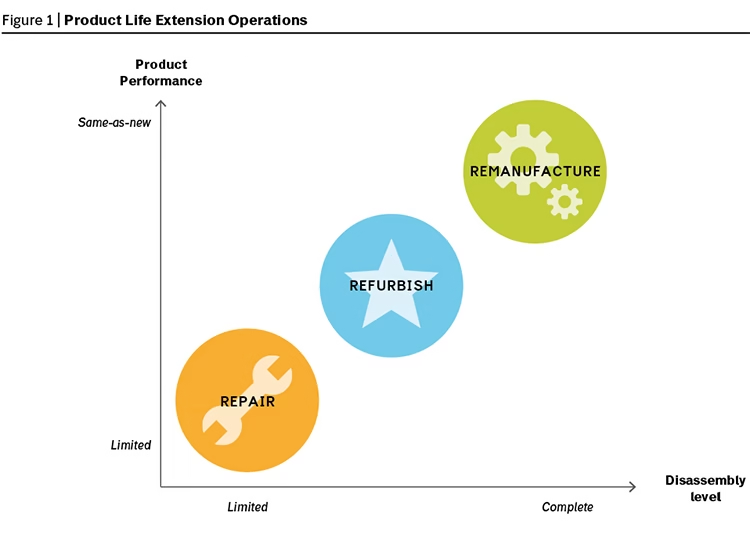
[1] Circular economy evidence building programme : Remanufacturing study. Zero Waste Scotland. March 2015.
[2] Remanufactured goods: An overview of the U.S. and global industries, markets, and Trade. U.S. International Trade Commission. 2011.
[3] Remanufacturing market study, European Remanufacturing Network, November 2015
[4] Automotive Parts Remanufacturers Association
[5] Triple Win: The Economic, Social and Environmental Case for Remanufacturing, All-Party Parliamentary Sustainable Resource Group, December 2014.
[6] Remanufactured goods: An overview of the U.S. and global industries, markets, and Trade. U.S. International Trade Commission. 2011.
[7] Next Manufacturing Revolution Report. Lavery and Pennell. 2013.
[8] No Ordinary Disruption: The Four Global Forces Breaking All the Trends. Richard Dobbs, James Manyika and Jonathan Woetzel. May 2015.
[9] Ibid.
[10] The Value of Remanufactured Engines: Life-Cycle Environmental and Economic Perspectives. V. M. Smith and G. A. Keoleian. Journal of Industrial Ecology. 2004.
[11] USITC (United States International Trade Commission), Remanufactured Goods: an Overview of the U.S. and Global Industries, Markets, and Trade, Washington, D.C. : USITC 2012.
[12] Triple Win: The Economic, Social and Environmental Case for Remanufacturing, All-Party Parliamentary Sustainable Resource Group, December 2014.
[13] Circular Economy Evidence Building Programme : Remanufacturing Study. Zero Waste Scotland. March 2015.
[14] Remanufacturing in Denmark, Incentive, 2015
[15] Remanufacturing market study, European Remanufacturing Network, November 2015
Connect with our circular economy consultants to know more